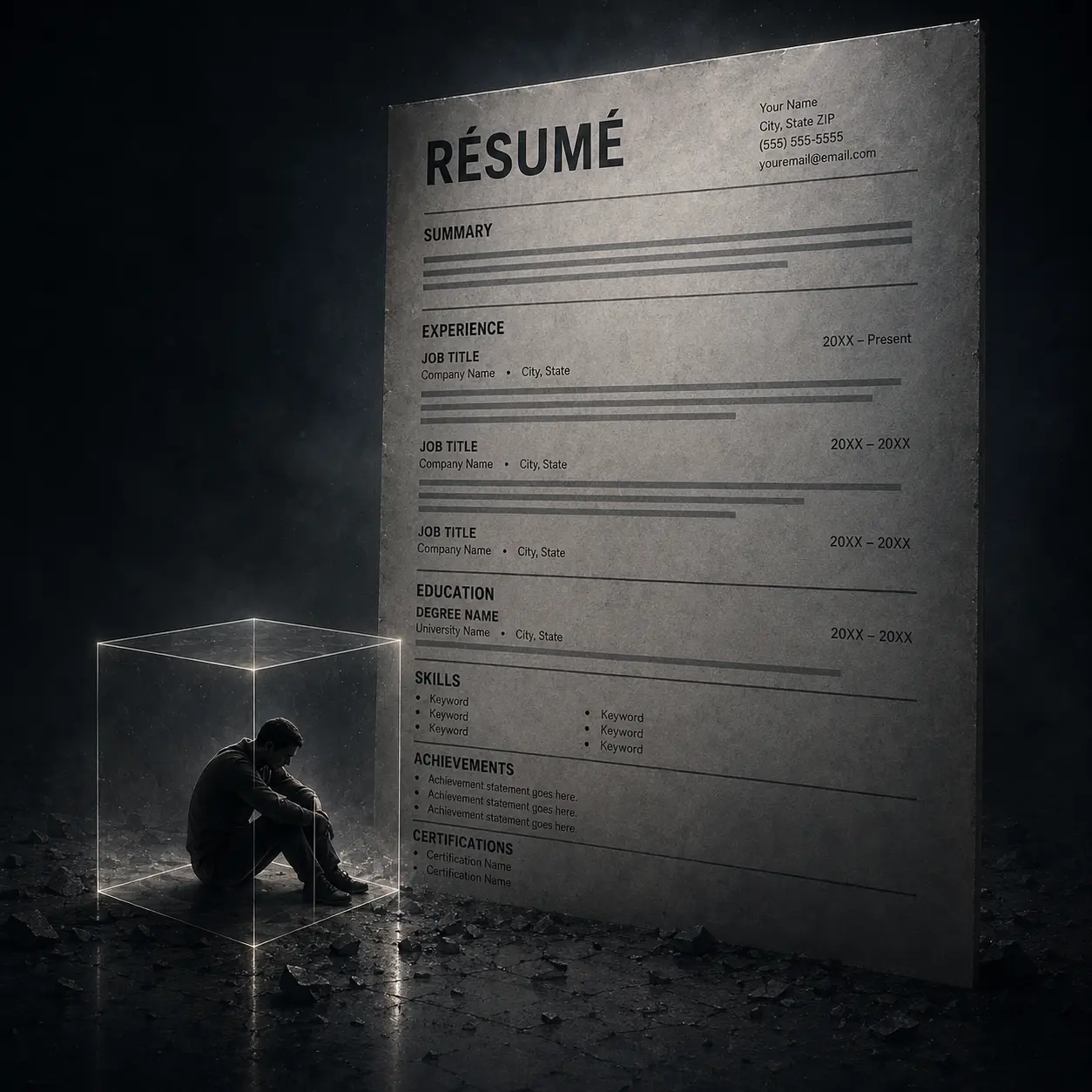
People become paperwork
Complex lives are reduced to titles, dates, credentials, and a handful of keywords chosen to fit one opening.
 Start Discovery
Responsible alignment for people and opportunity
Most hiring compares a compressed résumé with a compressed job description. Lighthouse uses Discovery to understand both sides in greater depth, then explains where real alignment, possible friction, and important questions exist.
Your résumé is just the first bite. Through conversation with you, we unpack the experience behind it—and reveal the person a page can’t hold.
Discovery is the mechanism. Responsible alignment is the outcome. Better information gives people a better place to begin the human decision.
AI Discovery is subject to service availability. It opens in your browser and is currently being refined with founding participants.

The problem Lighthouse was built to solve
A résumé can show job titles, dates, education, and selected accomplishments. It usually cannot explain how someone thinks, what they notice, how they learn, why they made certain choices, or how abilities from different parts of their life connect.
That matters most for veterans, technicians, career changers, makers, and people whose value crosses several fields. Their experience can look scattered on paper even when a strong, consistent pattern runs through all of it.
The problem is not that people lack value. The problem is that the hiring system often cannot see enough of it.
Complex lives are reduced to titles, dates, credentials, and a handful of keywords chosen to fit one opening.
Real teams, managers, pressure, support, culture, and expectations are reduced to a polished job description.
Then everyone wonders why a “good match” can become a painful job, a poor hire, or a talented person being overlooked.
The wall and the tiny car
Imagine judging every vehicle by whether it can pass through an opening built for a tiny car. When a larger, more capable vehicle cannot fit, the vehicle is treated as the problem.
That is what hiring often does today. It is an old design still shaping the current industry: ask a full human being to squeeze through the narrow opening of a résumé, then assume anything that did not fit must not matter.
Lighthouse does not keep shaving pieces off the person. It makes the entrance large enough to see who is actually there.
What happens after we eat your résumé?
After you upload your résumé, Lighthouse begins decompressing its shorthand: titles, responsibilities, and achievements become starting points for Conversational AI Discovery. Through conversation with you, relevant portions are reconstituted with the important details that were left out—what you meant, what you actually did, and why it mattered.
A bullet such as “improved workflow” might hide a moment when you spotted a costly problem, challenged an assumption, and built a solution others had missed. Discovery asks you to fill in the details: the constraints you faced, the decisions you made, your individual contribution, and the outcome. A few words become a clearer understanding of your capabilities.
When an experience deserves a closer look, it can become a case study in your Lighthouse Profile, with your approval, for employers to explore. They can see how you think and act in real situations—depth a résumé cannot convey and a typical interview may never uncover.
Why this matters now
Many hiring tools use AI to scan the same résumés and job descriptions the industry has always used. That can make filtering faster, but it does not make the underlying picture more complete. Lighthouse uses AI for a different purpose: to ask better questions, connect evidence, preserve context, and help both sides become clearer before anyone is evaluated.
Discovery
Discovery is the cornerstone of Lighthouse. Before a person and an opportunity can be meaningfully aligned, we need to understand how that person creates value and what the work, manager, team, and environment actually require. A résumé and a job description are starting points for that understanding.
High-resolution alignment can only be as accurate as the understanding behind it. Without comprehensive Discovery on both sides, important strengths, needs, and conflicts remain hidden. Lighthouse’s distinction is the depth of what it discovers before the comparison begins.
Meet A.L.I.C.E.
A.L.I.C.E. is your guide through a live Discovery conversation inside Lighthouse. She does not march through a rigid questionnaire or make you perform for an algorithm. She follows what matters, asks for examples, changes direction when a thread has run its course, and helps you put language around things you may have understood without ever naming.
You can pause, return later, correct what was misunderstood, and decide whether an interpretation feels true. The goal is not to impress A.L.I.C.E. The goal is to help her understand what is already there.

Begin with your work, your life, a problem you solved, or something that never made sense on your résumé.
Upload artifacts when they help: documents, examples, portfolios, certifications, notes, or project material.
Lighthouse links the stories and evidence that point to a repeated capability or working pattern.
You confirm, correct, deepen, or reject what Lighthouse believes it has learned.
You decide what leaves your private space, who can see it, and what purpose it may be used for.
Participant Discovery
Discovery is a guided conversation supported by the materials you choose to provide: a résumé, work history, portfolio, project notes, performance examples, certifications, job postings, or anything else that helps explain your experience. Those materials are evidence, not the whole story.
Discovery is a live conversation between you and A.L.I.C.E. As you talk, she follows the relationships between your stories. She looks for repeated ways you solve problems, learn new systems, help other people, respond under pressure, build trust, improve a process, or create something that did not exist before.


Opportunity Discovery
A role may look perfect on paper and still be wrong for the person—or the person may look unconventional on paper and be exactly what the team needs. The missing information is often on the opportunity side.
Through Discovery conversations with the hiring manager and people who know the work, Lighthouse helps reveal what the work actually requires, how success will be judged, how the manager leads, how the team communicates, how much autonomy exists, what pressure is normal, what support is available, why the role is open, and what nobody knows yet.
A person is more than a résumé. An opportunity is more than a job description. Responsible alignment requires the truth on both sides.
What must actually be accomplished, which capabilities matter, and what success looks like beyond a list of duties.
How decisions happen, how feedback is given, where support exists, and which working relationships shape the role.
Pace, pressure, autonomy, structure, tools, constraints, culture, and the conditions a participant will encounter every day.
What the organization cannot yet promise, where tension may exist, and what must be explored together before a decision.
Your private workspace
Your conversations, uploaded artifacts, evidence, profile drafts, corrections, and sharing choices live together in one protected space. You can see what Lighthouse believes it has learned and what evidence supports it.
You can correct a detail, reject an interpretation, add context, or leave a question open. Participant correction is not treated as a system error. It is part of Discovery.

Your Discovery map
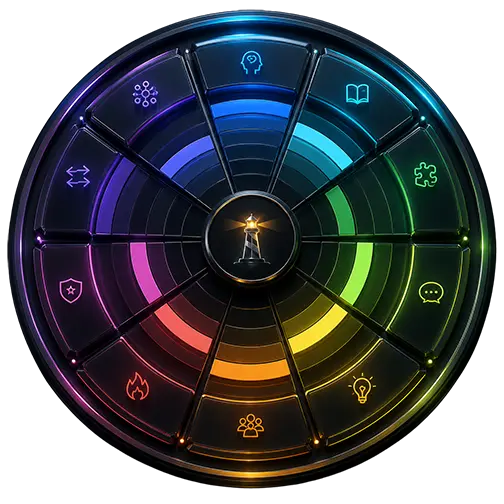
The map is not a score and it is not a progress grade. It simply shows which parts of your professional story have strong evidence, which patterns you have confirmed, which ideas are still emerging, and which areas have barely been explored.
An incomplete map does not mean an incomplete person. It means Lighthouse is being honest about what it does and does not know.
What a Lighthouse Profile can contain
The profile brings together the most useful parts of Discovery and the participant’s traditional materials. Every important statement should connect to evidence, participant confirmation, or a clearly marked inference.
Profiles can change as new work, evidence, goals, and understanding emerge. Completing one Discovery session never means Lighthouse believes it has completed the person.

Why Paul built Lighthouse
“On paper, they often looked like separate lives.”
As an F-16 crew chief in the U.S. Air Force, Paul was trusted as the personal crew chief for a Wing Commander’s aircraft. Years later, while processing Census data, he authored the operating procedure for a data center handling more than a million forms a day. In commercial print production, he pushed an HP Indigo 100K to nearly 300,000 impressions in 24 hours.
Those achievements belong to different industries, but the underlying capability is consistent. Paul learns complex systems quickly, notices where they fail or become unclear, and creates a practical way for people and machinery to work better together.
Paul became Lighthouse’s first Discovery participant. The result did more than improve his résumé. It revealed the consistent human capability that the résumé had hidden.
That was the moment Lighthouse stopped being a job-search idea and became an obligation: build a better way for people to be discovered, understood, and represented without making them smaller first.Future vision and historical design illustration. Not an operational service.
Alignment—not keyword matching
Most matching systems compare one incomplete summary with another and calculate whether the words are close enough. Lighthouse compares evidence-backed participant capabilities with the real needs and conditions of an opportunity.
It asks practical questions: Can this person do the work? Will this environment let them do it well? Does the role use what they naturally bring? Are there tensions that could become harmful? What still needs a human conversation?
Capabilities, evidence, work needs, motivation, environment, and support genuinely reinforce one another.
The work may underuse the person, the environment may fight how they work, or an important condition may be missing.
Lighthouse makes uncertainty visible so an interview can explore it instead of hiding it behind a percentage.
The decision remains human
Lighthouse does not declare a winner, assign human worth, or make the hiring decision. An opportunity may have one strong alignment, five, or ten. Recruiters, hiring managers, teams, and participants still talk, interview, ask questions, use judgment, and choose.
The difference is that the conversation begins with more truth and less guesswork. Instead of spending the interview reconstructing what a résumé left out, people can explore the evidence, the opportunity, the possible fit, and the questions that matter most.
For recruiters and hiring teams
With the participant’s permission, Lighthouse can provide a clear candidate package: evidence-backed capabilities, relevant case studies, confirmed context, working conditions, possible alignment, possible friction, and the questions worth asking next.
This is not a prettier ATS profile. It is a better starting point for human evaluation—and a way to notice people whose transferable or cross-disciplinary capability would otherwise be filtered out.
See the stories, artifacts, outcomes, and context behind an important capability claim.
Understand how the person approached a real problem, what they did, and what changed because of it.
See why the person and role may fit, where tension may exist, and what remains uncertain.
Spend the conversation testing the right things instead of decoding a compressed résumé.
The screening boundary
Future vision and historical design illustration. Not an operational service.
The participant experience
Lighthouse is currently in its founding-participant phase. The experience is being built around these connected spaces, with participant feedback shaping how each one works.
Lighthouse is in its first stage of development, and Founder Participant profiles can be created now. Every profile and participant space created during this phase will receive a gold Founder highlight when viewed digitally, along with a dedicated Founder frame on printed profile copies.

See your Discovery status, recent activity, next useful steps, and current sharing choices.
Talk naturally with A.L.I.C.E., return to earlier threads, and add context over time.
See what has strong evidence, what is emerging, and what has not yet been explored.
Open a profile statement and see the stories, artifacts, and confirmations behind it.
Approve, edit, reject, or add context before an interpretation becomes part of your profile.
Choose what may be shared, with whom, for what purpose, and for how long.
Let an authorized recruiter explore your capabilities and ask better, evidence-based questions.
See the real role, manager, team, expectations, conditions, and unresolved questions.
Lighthouse is being built at a brisk pace. Some areas are not yet available because they are scheduled for near-term development. The progress indicators above show where each module currently stands.
How the business is designed to work
People should not have to pay simply to be understood or become visible. Participant Discovery and profile creation are intended to remain free. Employers and opportunity-side partners fund the system when Lighthouse helps produce a successful placement.
A participant does not buy a better ranking, pay for visibility, or lose access because they cannot afford a profile.
Lighthouse earns an agreed placement or award fee after a candidate is hired—not for quietly pushing people toward jobs.
A portion of the opportunity-side fee is intended for the person who was hired, recognizing that the candidate also created the value.
The candidate’s share is separated from Lighthouse’s operating money so the system cannot profit by pressuring someone to accept the wrong role.
Payment never determines visibility or ranking. Participants control whether their profiles appear in relevant searches. Optional paid services provide additional tools and support; they do not determine whose profiles are included or give anyone a higher ranking. Neither participants nor employers can pay for preferential placement.
The larger mission
When a person’s abilities fit the work and the environment supports how they do their best work, more than productivity can improve. They may carry less dread home. They may regain confidence. Teams may lose less talent. Managers may spend less time repairing preventable mismatches. Families and communities may feel the difference too.
Lighthouse will not solve every problem in work or in life. But helping people become more accurately understood—and helping them find places where they can genuinely contribute and thrive—is a practical place to begin.
This is not a white-label hiring tool with a nicer interface. It is an attempt to change the quality of the first understanding between a human being and an opportunity.Experience it for yourself
The current Discovery Engine lets you begin a real conversation with A.L.I.C.E. You do not need a polished résumé or the “right” opening answer. Start with a job that never fit on paper, a problem you solved, a change you want to make, or simply what brought you here.
Founding participants and partners
If you have ever felt that your résumé could not carry the most important truth about your work, Lighthouse is being built for you. If you hire people and know that a job description cannot carry the full truth of an opportunity, Lighthouse is being built with you in mind too.
We are inviting early participants to test the live system without stripping away the principles that make it worth building. Employers, workforce partners, funders, and thoughtful critics can also begin inside the Discovery Engine and identify why they came.
Lighthouse is in its founding-participant phase. Early participants will help shape the experience while the core promise remains protected.